

“Mature love is union under the condition of preserving one’s integrity, one’s individuality. Love is an active power in man; a power which breaks through the walls which separate man from his fellow men, which unites him with others.”
— Erich Fromm, The Art of Loving (1956)
The exhibition The Art of Loving imagines a shared narrative through private archives. Here, “collecting” is not simply an act of accumulating or preserving objects. Rather, it is a practice of retracing the traces of others, connecting their time and memories to one’s own life, and extending microscopic, individual experiences into a shared social sensibility. One person’s records and experiences inevitably come into contact with those of another, allowing individual narratives to form a collective context. Such accumulation does not culminate in the archive as a closed and complete system of knowledge; instead, it produces a relational field that remains continually open to the outside.
For Erich Fromm, love is not a passive emotional event that happens by chance. He describes love as an “active skill (art),” understanding it as a capacity cultivated through discipline, practice, and sustained effort. Love is not confined to a feeling directed toward a particular object or person, but constitutes an attitude toward the world and toward others—a mode of being. In other words, love is not possession but concern; not domination but care; not the affirmation of sameness but the capacity to accept difference. Fromm proposes that love comes into being through four fundamental elements: care, responsibility, respect, and knowledge. Love, then, does not mean subsuming the other within one’s own desire, but rather recognizing the other in the singularity of their existence and continually responding to them as such.
From this perspective, the exhibition turns away from love understood through the logic of exchange, in which it is reduced to market value; from love as possession; and, further still, from love confined to the satisfaction of individual desire. Instead, it attends to love as a practice performed in relation to the other’s mode of existence. To this end, AN Chorong revisits photographic records made by others. For the artist, the photographic image is a latent form that begins as data and continually demands to be interpreted and expanded within new contexts. A photograph is thus at once a private commemoration of a particular time and place and an image that, as though harboring a desire of its own, anticipates active interaction with external contexts and with others. In the exhibition, AN gives new bodies to images received from others or acquired by chance, exploring relationships mediated through photography. For instance, the awkwardness of having one’s affection and intimacy toward another mediated by a landscape image on a postcard—an image otherwise unrelated to oneself—is separated and condensed into the forms of a perforated postcard and a pendant (the Lake of Milk from Dew 2011 (Round Ver.) and the Lake of Milk from Dew 2011 (Frame Ver.)). Here, the hole might be understood as a relational structure that operates precisely because it is empty. Rather than signaling damage or absence, it foregrounds a meaning structured through lack. The opening exceeds the order of the edited image on the postcard—the landscape as an ideological surface in which fragments of place have been selectively framed and compressed according to a particular gaze—and functions as a portal that evokes an intimate relationship beyond the scenery (the Lake of Milk from Dew 2011 (Frame Ver.)). Meanwhile, the image detached from the postcard acquires a corporeal presence as an object small enough to be held in one’s hand, animating dispersed memories in the present while holding them from disappearing (the Lake of Milk from Dew 2011 (Round Ver.)). Elsewhere, everyday landscapes photographed by the artist’s mother are physically attached to and overlaid with film photographs taken by AN within a single frame. From a printer placed above them, intimate records of unidentified figures found on anonymous rolls of film are regularly printed and distributed (Borrowed Scenes). In this way, AN positions herself as a mediator of photographic images, receiving, recontextualizing, and transmitting them anew. Her photographic practice encompasses images taken by her, but also by others, or photographs circulated within particular systems, and even photographs encountered by chance. By turning these mute images drifting through everyday life into events, she attempts to open points of contact with others.
In LEE Kang Seung’s work, meanwhile, the archive is less a complete epistemological system for preserving and classifying the past than a relational practice through which lives omitted from history, or never adequately mourned, are summoned into the present. Collecting and reconfiguring official and private records, photographs and language, objects and plants, and other organic matter, the artist connects traces of queer lives excluded from dominant historical narratives. Here, collecting is not an attempt to speak on behalf of those who have disappeared, nor to stitch their lives together into a coherent and unified history. Rather, it is an act of maintaining the gaps within incomplete traces while creating a provisional space in which figures belonging to different times and places might encounter one another. In this sense, LEE’s archive can be understood less as a mode of preservation than as a form of care. This is because it involves not merely discovering materials from the past, but repositioning another person’s life and memory under the gaze of the present. Its ethics derive not from reconstructing a complete narrative, but from preserving the gaps in the record, anonymity, and the opacity of the other. The series A Diary of Flower, for example, is based on images of plants collected from a small garden that Ed Aulerich-Sugai tended with his partner until his death from AIDS in 1994. Rather than bringing an explicit personal narrative or event to the foreground, the work allows images of flowers embroidered onto burlap to stand in its place. Here, the flowers are not decorative elements positioned at the margins of a record. They become indirect portraits of another person, carrying emotions and desires that language alone cannot fully contain. LEE further imagines a shared future in Untitled (The Future Perfect). The materials comprising the work—dried flowers and leaves, meteorites, ceramic objects made from collected soil, fossilized copper, and other substances carrying distinct temporalities and geographies—do not function as relics of the past, but as materials that evoke a time yet to come. Embroidered in gold thread on burlap are sentences collected from the artist’s peers, each written in the future perfect and beginning with the phrase “When the future comes,” Together, they embody aspirations toward a collective queer future. The objects arranged across the work according to their own coordinates—fossils, plants, and other matter—carry geological durations that exceed or fall beneath the scale of a human lifespan, bringing multiple temporal strata together within a single field. The future is thereby proposed not as an individual projection, but as a collective narrative written through a multiplicity of voices. For LEE, memory is not fixed information but something continually transformed and transmitted through bodies and materials. His work is therefore not a repository for storing the past, but a medium through which memory enters into new relationships across generations and geographies. In this way, LEE’s practices of collecting and recording become a “living archive,” in which private and communal histories collide and intersect.
Lastly, NOH Songhee has transformed fragmentary records—such as existing floor plans, fax transmissions, and drawings—into moving images, giving them new spatiotemporal rhythms and narratives. For this exhibition, she follows traces encountered by chance in everyday life, constructing a kind of map from these microscopic clues. What catches her attention are the handprints of delivery workers left on the rear doors of logistics vehicles. If trucks traversing the city along predetermined routes and toward assigned destinations visualize the efficiency and speed of the logistics system, the handprints remaining on their surfaces unexpectedly reveal the bodily presence that keeps that system in motion. These marks are neither the products of labor nor intentionally produced records. They are traces of contact accumulated almost inadvertently through repetitive bodily gestures: pushing doors open and shut, loading goods, and unloading them. Perhaps precisely because of their unintentional and incomplete nature, these handprints bear witness to individual time and movement that official records of labor fail to capture. Appearing like ghosts across the gallery windows, wall drawings, and video images, these hands overlap and disappear, forming a collective yet unidentifiable abstract portrait. The bodily traces that suddenly emerge upon the standardized surfaces of logistics become signs of humanity briefly surfacing within an impersonal system, as well as silent utterances left behind by labor performed without a voice. Noh traces the locations in which these marks appeared and the routes along which they moved. Yet the map she constructs differs from a conventional map that surveys the city from a fixed distance and diagrams its roads and districts. Rather than representing the systematized city as a totality on a macroscopic scale, hers is closer to a micropolitical form of cartography that begins with a single handprint and follows the movements and relations it implies. Freight vehicles circulate ceaselessly throughout the city, but what the artist records is not their precise points of departure and arrival. Instead, she traces the bodily contact, friction, repetition, and fatigue that made such movement possible. The map here is therefore not an objective tool for describing an already existing space, but a performative device that enables the city to be sensed anew by following trajectories of labor that ordinarily remain unseen. Seen in this light, Noh’s act of collecting is far removed from any attempt to construct a total archive containing complete information. Rather, it discovers clues missing from official systems of documentation and uses these fragments to imagine realms of life that have remained unrecorded. Traces of bodies and labor invisible from a distant view of the city form, through the artist’s pursuit, new routes akin to veins running beneath its surface. The map she produces can therefore be understood as a kind of negative image: one that follows the gestures of microscopic lives in order to reveal, in reverse, the underside of a macroscopic system.
In this way, the three artists arrive at distinct methodologies: AN Chorong receives and redistributes images, altering the routes through which relationships circulate; LEE Kang Seung rearranges fragments of incomplete memory to imagine solidarities that cross time and generations; and NOH Songhee traces and maps the bodies of workers that hover like ghosts at the edges of everyday life, never entering official systems of documentation. Together, their practices demonstrate how collecting and recording might become not acts of possession, but multiple techniques for entering into solidarity with others. Love is not confined to a relationship with a particular “object” or person; it can be understood as an “attitude” that shapes the entirety of how one encounters the world and others. Memories of another person may be attributed to an individual through acts of recording, yet the very form of the record bears traces of the social conditions and relationships through which it was produced, retaining the potential to travel toward other times and other beings. Love, in this sense, does not consist in completely understanding or possessing another within one’s own narrative. Rather, it becomes a practice of continually creating possibilities for connection while allowing each person to retain their singularity. Love, then, is not merely a matter of emotion, but an act for living together—an ethical orientation through which communities may be sustained and continually constituted anew.
Credit
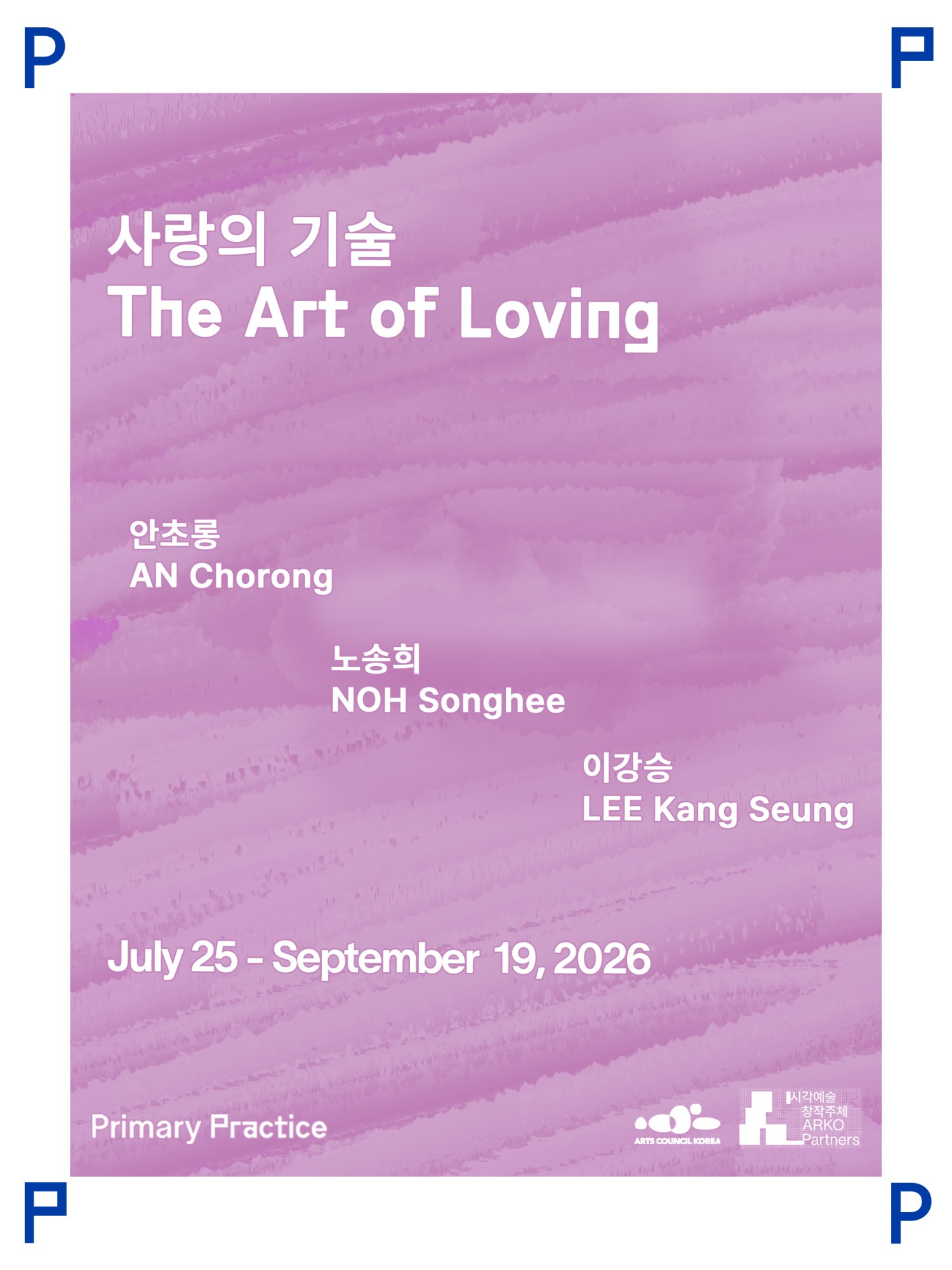
Participating artists : AN Chorong, LEE Kang Seung, NOH Songhee
Curated by KIM Sung Woo
Text by KIM Sung Woo
Space construction : Mujindongsa
Media installation : comp 1
Photo : CJY ART STUDIO
Supported by Arts Council Korea